
Mitochondria and ageing
Epithalon research: the pineal tetrapeptide, telomerase and ageing studies
Updated 14 October 2026 · 4 min read
Epithalon is a four-amino-acid peptide modelled on an extract of the pineal gland. Russian studies linked it to telomerase activity in human cells and to longer maximum lifespan in mice. This overview explains what those studies found, what a recent review concludes, and how much is still unknown.
From a pineal extract to a tetrapeptide
Epithalon, also written Epitalon or Epithalone, is the synthetic tetrapeptide Ala-Glu-Asp-Gly (AEDG). It was designed at the St Petersburg Institute of Bioregulation and Gerontology, in Vladimir Khavinson's group, based on the amino acid composition of Epithalamin, a polypeptide extract of bovine pineal glands. As Araj and colleagues note in their 2025 review, the tetrapeptide was synthesised before it was later identified in a pineal polypeptide preparation.
It belongs to a family that Khavinson's group calls peptide bioregulators: very short peptides proposed to act on gene expression in specific tissues. Thymalin and Cartalax are other members of this family in our catalogue.
Telomerase in human cells
Telomeres are protective caps at the ends of chromosomes that shorten each time most cells divide, and the enzyme telomerase can rebuild them. Most adult somatic cells have little or no telomerase activity, which is one reason they can only divide a limited number of times.
In a short 2003 report, Khavinson, Bondarev and Butyugov added Epithalon to cultures of telomerase-negative human fetal fibroblasts. They reported that it induced expression of the catalytic subunit of telomerase, switched on telomerase activity and lengthened telomeres. The authors interpreted this as reactivation of the telomerase gene in somatic cells.
Lifespan in mice
The most cited animal study is by Anisimov and colleagues, also from 2003. Female outbred SHR mice received either saline or Epithalon for five consecutive days every month from the age of three months until natural death, with 54 mice in each group. The findings were mixed in an informative way:
- Food intake, body weight and mean lifespan did not change.
- The age-related switching-off of the oestrous function was slowed.
- Chromosome aberrations in bone marrow cells fell by 17.1%.
- The lifespan of the last 10% of survivors increased by 13.3%, and maximum lifespan by 12.3%.
- Total spontaneous tumour incidence did not change, but leukaemia was six times less frequent than in controls.
Proposed mechanisms
Araj and colleagues reviewed about 25 years of in vitro, in vivo and computational research on Epithalon. The studies they summarise describe antioxidant, nerve-protective and antimutagenic effects, a direct influence on melatonin synthesis by the pineal gland, changes in interleukin-2 mRNA levels, effects on the mitogenic activity of mouse thymus cells, and increased activity of several enzymes, including acetylcholinesterase, butyrylcholinesterase and telomerase.
The review is candid about the gaps: it remains uncertain whether these are the only or main mechanisms, and despite the volume of biological research, physico-chemical and structural studies of the peptide itself are still quite limited.
Reading the evidence carefully
Epithalon's research record has three clear limits. First, most studies come from one research school in St Petersburg and its collaborators, and independent replication is scarce. Second, the key studies are small: the telomerase report is a brief communication, and the lifespan study used one strain of female mice. Third, the lifespan findings concern the longest-lived animals and maximum lifespan, while mean lifespan did not change. Together these make Epithalon an interesting research peptide with intriguing early findings rather than an established one.
Telomeres and telomerase in brief
Each chromosome ends in a telomere, a long run of the repeated DNA sequence TTAGGG bound by protective proteins. Because the cell's copying machinery can't fully copy the very end of a DNA strand, telomeres shorten a little with each division. When they become critically short, cells stop dividing and enter senescence. Telomerase is the enzyme that adds the repeats back. It is active in germ cells, stem cells and most cancer cells, but largely silent in adult somatic cells. That is why the report of telomerase reactivation in fibroblasts attracted attention, and also why such findings need careful follow-up: unchecked telomerase activity is a hallmark of cancer cells. Telomere length is usually measured by quantitative PCR or by terminal restriction fragment analysis.
Key terms
- Bioregulator: the name Khavinson's group uses for very short peptides proposed to regulate gene expression in specific tissues.
- TERT: the catalytic subunit of telomerase, whose expression usually limits the enzyme's activity.
- Senescence: a state in which cells stop dividing but remain alive and metabolically active.
- Maximum lifespan: the lifespan of the longest-lived animals in a group, as opposed to the average.
- Geroprotector: a term used in ageing research for a substance proposed to slow age-related changes.
What a follow-up study would need
Independent replication is the main gap. A convincing cell study would test several cell types in different laboratories, measure telomerase activity with a validated assay, measure telomere length directly, and use blinded analysis. A convincing animal study would use both sexes, more than one strain, enough animals to detect differences in survival, and full survival curves rather than a few summary figures. Until such studies are published, Epithalon remains a peptide of interest rather than one with settled effects.
In summary
Epithalon is a simple tetrapeptide with a complex research story: a telomerase finding in cultured human cells, a mouse study with effects on maximum but not mean lifespan, and a recent review describing many proposed mechanisms. It is an interesting tool for ageing research whose effects still need independent confirmation.
Notes for laboratory work
Epithalon is a small, hydrophilic peptide (four amino acids, about 390 g/mol) that dissolves readily in water and has no methionine or cysteine, so it is relatively robust. Store the lyophilized powder frozen and dry, and prepare solutions shortly before use; see handling lyophilized peptides. For telomerase studies, a validated telomerase activity assay and telomere length measurement in the same cells give the most convincing picture.
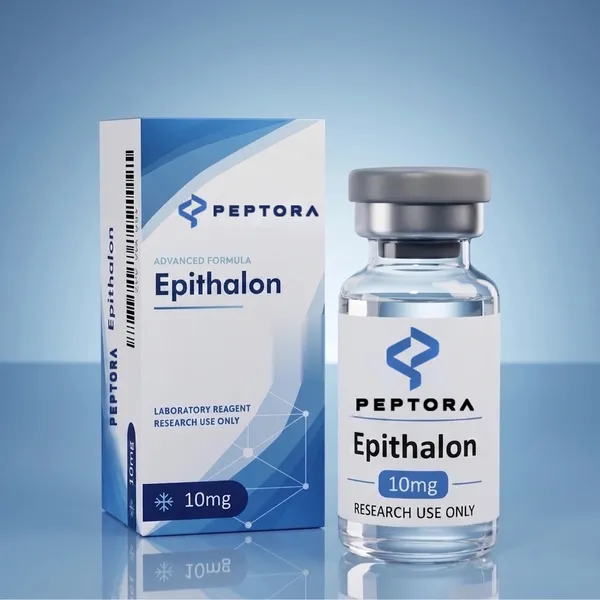
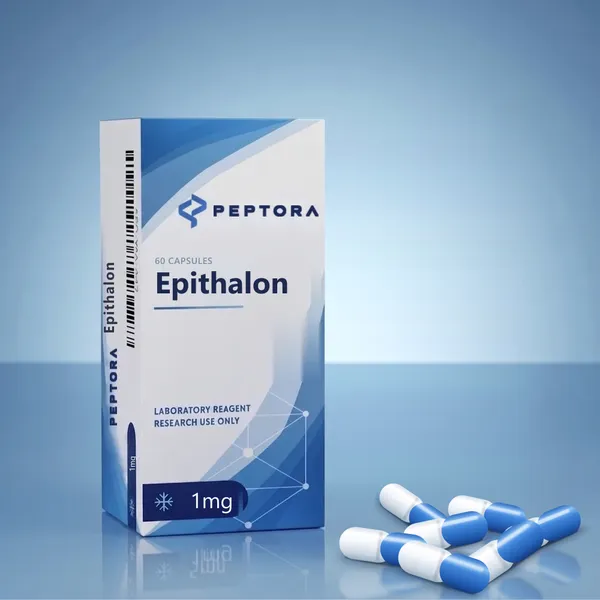
We offer Epithalon as a lyophilized powder and as Epithalon capsules for research designs that need an oral format. For other research on cellular ageing, see MOTS-c and SS-31 and our NAD+ research overview.
Frequently asked questions
What is Epithalon made of?
Four amino acids: alanine, glutamic acid, aspartic acid and glycine (Ala-Glu-Asp-Gly, or AEDG).
Does Epithalon activate telomerase?
One 2003 study reported that it induced telomerase activity and telomere elongation in cultured human fetal fibroblasts. Independent replication is limited.
Did Epithalon extend lifespan in mice?
In one study of female SHR mice it did not change mean lifespan but increased maximum lifespan by 12.3% and the lifespan of the longest-lived 10% by 13.3%.
References
- Khavinson VKh, Bondarev IE, Butyugov AA. Epithalon peptide induces telomerase activity and telomere elongation in human somatic cells. Bull Exp Biol Med. 2003. PubMed
- Anisimov VN, Khavinson VKh, Popovich IG, et al.. Effect of Epitalon on biomarkers of aging, life span and spontaneous tumor incidence in female Swiss-derived SHR mice. Biogerontology. 2003. PubMed
- Araj SK, Brzezik J, Mądra-Gackowska K, et al.. Overview of Epitalon: highly bioactive pineal tetrapeptide with promising properties. Int J Mol Sci. 2025. PubMed
For laboratory research use only. Not for human or veterinary use. This article summarises published research and is not advice about personal use. You must be 21 or older to order.