
Mitochondria and ageing
NAD+ research: the cofactor behind energy metabolism, sirtuins and ageing
Updated 14 October 2026 · 4 min read
NAD+ is a coenzyme found in every living cell. It carries electrons in energy metabolism and fuels enzymes that regulate DNA repair and gene expression. Its levels fall with age, and restoring them in animals improved health and lifespan, which has made NAD+ and its precursors a major research topic.
What NAD+ is
Nicotinamide adenine dinucleotide (NAD) is a coenzyme found in all living cells. It exists in an oxidised form, NAD+, and a reduced form, NADH. As Verdin explains, it has two jobs. First, it is a coenzyme for the oxidation-reduction (redox) enzymes of energy metabolism, carrying electrons from one reaction to the next in glycolysis, the citric acid pathway and the mitochondrial respiratory chain. Second, it is a co-substrate that is consumed by other enzymes, notably the sirtuins and the poly(ADP-ribose) polymerases (PARPs).
The enzymes that use it up
Covarrubias, Perrone, Grozio and Verdin describe three families of NAD+-consuming enzymes that matter most for research:
- Sirtuins, which remove acetyl groups from proteins and help regulate metabolism, gene expression and stress responses.
- PARPs, which use NAD+ to signal and repair DNA damage.
- CD38 and related enzymes, which break down NAD+ and are especially active in immune cells.
NAD+ falls with age
A gradual decline in NAD+ in tissues and cells with age has been seen in many model organisms, including rodents and humans. The 2021 review links this decline to processes including metabolic disease, cognitive decline, loss of muscle mass and frailty, and notes that in animal models many of these changes can be slowed or even reversed by restoring NAD+ levels. Rising CD38 activity and greater demand from DNA repair are among the proposed reasons for the decline.
Restoring NAD+ in animals
Rajman, Chwalek and Sinclair reviewed the in vivo evidence for NAD-boosting molecules. They describe how NAD+ rises and falls with food intake, exercise and the time of day, and how restoring NAD+ in old or diseased animals has been reported to promote health and extend lifespan. This has prompted a search for safe and effective ways to raise NAD+, which in practice means supplying its precursors.
Precursors: NR and NMN
NAD+ itself is a large, charged molecule that does not cross cell membranes easily, and outside cells it is broken down by enzymes such as CD38 and CD73. Much research therefore uses smaller precursors that cells convert into NAD+, especially nicotinamide riboside (NR) and nicotinamide mononucleotide (NMN). Yoshino, Baur and Imai reviewed both: they behave differently depending on the tissue, on the levels of the enzymes that convert them, and on transporters that are still being characterised.
What human studies show so far
In one of the first controlled studies, Martens and colleagues ran a randomised, double-blind, placebo-controlled crossover trial in healthy middle-aged and older adults, with two six-week periods. Chronic NR supplementation was well tolerated and effectively raised NAD+ metabolism. The authors saw early signals worth testing further, particularly for blood pressure and arterial stiffness, and called for larger trials. As the 2021 review notes, much remains to be learnt about whether raising NAD+ is safe and useful in ageing humans.
NAD+ and mitochondria
Because so much NAD+ turnover happens in mitochondria, NAD+ research overlaps with research on mitochondrial peptides. MOTS-c, for example, acts on metabolism through AMPK, an energy sensor that interacts with NAD+-dependent sirtuin signalling. See MOTS-c and SS-31 for those peptides.
How cells make NAD+
Cells have three routes to NAD+. The de novo pathway builds it from the amino acid tryptophan. The Preiss-Handler pathway starts from nicotinic acid (niacin). The salvage pathway, the most important in most tissues, recycles nicotinamide, which is released whenever sirtuins, PARPs or CD38 use NAD+, back into NAD+ through the enzyme NAMPT and the intermediate NMN. Nicotinamide riboside enters this salvage route after nicotinamide riboside kinases convert it to NMN. Because NAMPT sets the pace of salvage, it is a common target in NAD+ research. Each route is regulated separately, so a precursor can raise NAD+ in one tissue more than in another, as Yoshino and colleagues describe.
Key terms
- NAD+ and NADH: the oxidised and reduced forms of nicotinamide adenine dinucleotide.
- Sirtuins: NAD+-dependent enzymes that remove acetyl groups from proteins.
- PARPs: poly(ADP-ribose) polymerases, which consume NAD+ to signal and repair DNA damage.
- CD38: an enzyme that breaks down NAD+, highly active in immune cells and rising with age.
- NAMPT: nicotinamide phosphoribosyltransferase, the rate-limiting enzyme of the salvage pathway.
- NR and NMN: nicotinamide riboside and nicotinamide mononucleotide, two NAD+ precursors.
Measuring NAD+ in experiments
NAD+ levels change quickly with time of day, feeding and cell state, so sample collection needs to be consistent. Common methods include enzyme-coupled assays and liquid chromatography with mass spectrometry, which can also measure NADH, NMN, NR and related metabolites in the same sample. Because NAD+ and NADH convert into each other easily, the extraction method decides which form is preserved: acid extraction for NAD+ and alkaline extraction for NADH. Reporting the ratio of NAD+ to NADH alongside total levels gives a fuller picture of a cell's redox state.
In summary
NAD+ sits where energy metabolism, DNA repair and gene regulation meet. Its decline with age and the effects of restoring it in animals explain the research interest, while human studies of precursors such as NR are still early, so careful measurement and well-designed experiments matter more than ever.
Notes for laboratory work
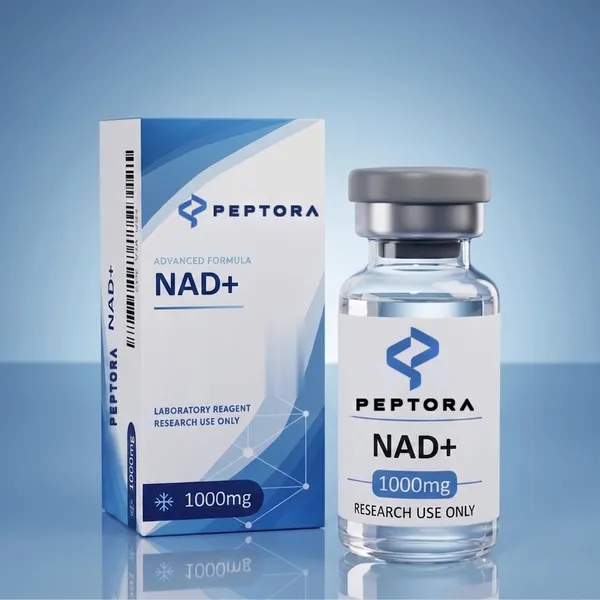
NAD+ is supplied as a lyophilized powder. It absorbs moisture readily, so keep vials sealed, frozen and dry, and let them reach room temperature before opening. NAD+ is much less stable in solution than as a powder, especially when warm or at alkaline pH, so prepare solutions in a neutral or slightly acidic buffer, keep them cold, and use them the same day where possible. Confirm concentrations by absorbance at 260 nm if precision matters, and remember that NAD+ and NADH are different compounds with different absorbance at 340 nm.
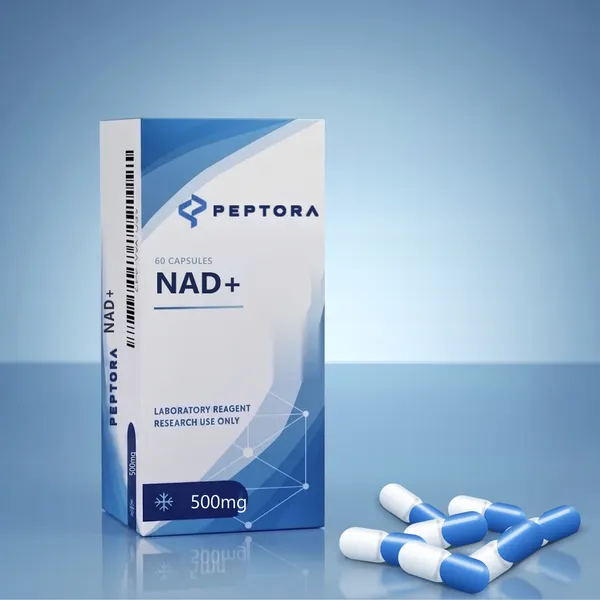
In cell experiments, extracellular NAD+ is partly broken down to smaller precursors before it enters cells, so the measured effect may reflect those precursors. We also offer NAD+ capsules for research designs that need an oral format. For general storage advice, see storing research peptides.
Frequently asked questions
What does NAD+ do in cells?
It carries electrons in energy metabolism and is consumed by enzymes such as sirtuins and PARPs that regulate gene expression and DNA repair.
Do NAD+ levels decline with age?
Yes. A gradual decline has been seen in many model organisms, including rodents and humans.
What are NR and NMN?
Nicotinamide riboside and nicotinamide mononucleotide, two precursors that cells convert into NAD+. They are widely used in research because NAD+ itself enters cells poorly.
How should NAD+ be stored?
As a dry powder, sealed and frozen. Solutions are unstable, especially when warm or alkaline, and are best used the same day.
References
- Verdin E. NAD+ in aging, metabolism, and neurodegeneration. Science. 2015. PubMed
- Covarrubias AJ, Perrone R, Grozio A, et al.. NAD+ metabolism and its roles in cellular processes during ageing. Nat Rev Mol Cell Biol. 2021. PubMed
- Rajman L, Chwalek K, Sinclair DA. Therapeutic potential of NAD-boosting molecules: the in vivo evidence. Cell Metab. 2018. PubMed
- Yoshino J, Baur JA, Imai SI. NAD+ intermediates: the biology and therapeutic potential of NMN and NR. Cell Metab. 2018. PubMed
- Martens CR, Denman BA, Mazzo MR, et al.. Chronic nicotinamide riboside supplementation is well-tolerated and elevates NAD+ in healthy middle-aged and older adults. Nat Commun. 2018. PubMed
For laboratory research use only. Not for human or veterinary use. This article summarises published research and is not advice about personal use. You must be 21 or older to order.