
Buying and lab guides
Handling lyophilized peptides in the lab: solvents, technique and concentrations
Updated 14 October 2026 · 4 min read
Dissolving a freeze-dried peptide is simple, but small choices about solvent, technique and arithmetic decide whether your solutions are accurate and stable. This guide covers the lab steps from a sealed vial to labelled, frozen aliquots.
What is in a lyophilized vial
A lyophilized (freeze-dried) peptide is a dry cake or powder left behind when a frozen peptide solution has its water removed under vacuum. Wang's review of lyophilization explains why this dry form is so much more stable than any solution. The trade-off is that the material has to be dissolved before most lab work, and that step is where accuracy and stability can be lost.
Remember that the powder is usually a salt. Counter-ions such as acetate or trifluoroacetate, plus a little residual water, make up part of the weight, so the amount of free peptide is lower than the gross weight on the label. The lab report tells you what the declared amount refers to.
Before you open the vial
- Let the sealed vial reach room temperature (15 to 30 minutes) so no condensation forms inside.
- Tap the vial or spin it briefly in a centrifuge so all the powder sits at the bottom.
- Check the batch number against the lab report and note it in your records.
- Work on a clean surface with gloves and eye protection, and read the safety data for the material.
Choosing a solvent
Solubility depends on the sequence. Peptides with many charged residues usually dissolve readily in water; hydrophobic peptides may need help. Common lab choices are:
- Sterile water: the default for most hydrophilic peptides.
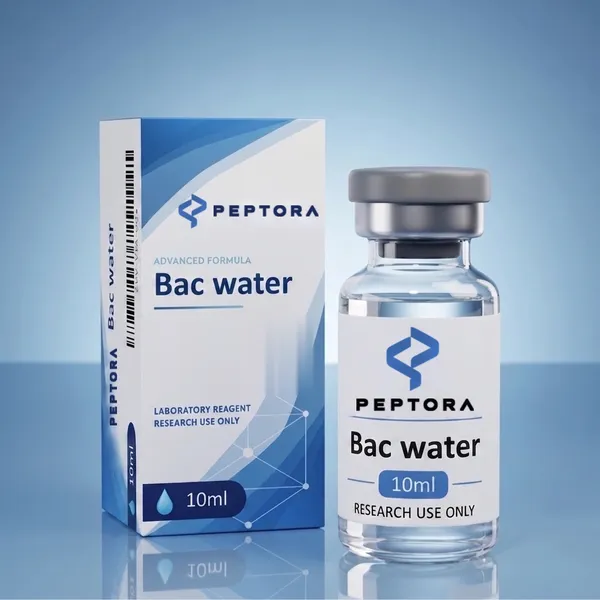
- Bacteriostatic water: sterile water with 0.9% benzyl alcohol, which limits bacterial growth in a vial that will be opened several times. Benzyl alcohol can affect some sensitive cell assays, so use plain sterile water where that matters.
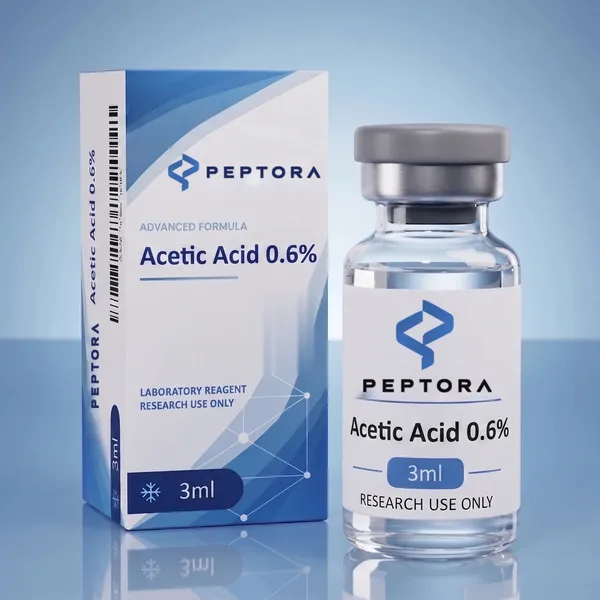
- Dilute acetic acid, such as our 0.6% acetic acid solution: helps dissolve basic peptides and some that resist neutral water.
- A small amount of an organic solvent such as DMSO, followed by dilution with buffer: an option for very hydrophobic peptides in in vitro work, provided the final solvent level suits your assay.
Test a small portion first
If you are not sure how a peptide will behave, dissolve a small portion first rather than committing the whole vial. If it doesn't dissolve, you still have most of the material to try a different solvent.
Technique: gentle, clean and slow
Add the solvent slowly down the inside wall of the vial rather than straight onto the powder, then swirl or roll the vial gently until the solid has dissolved. Avoid vigorous shaking or vortexing: foaming and the air-liquid interface it creates can promote aggregation, one of the physical instability routes described by Manning and colleagues. Give stubborn material a few minutes to dissolve before adding more solvent; brief sonication in a water bath can help some peptides.
For cell culture, pass the solution through a 0.22 µm sterile filter into a sterile container, and handle it in a laminar-flow cabinet where possible.
Working out the concentration
The concentration of your solution is simply the amount of peptide divided by the volume of solvent. For example, 5 mg dissolved in 2 mL gives 2.5 mg/mL, and 10 mg in 2 mL gives 5 mg/mL. If the lab report gives a net peptide content, multiply the gross weight by it first: 10 mg of material at 80% peptide content holds 8 mg of peptide, so 2 mL gives 4 mg/mL.
For experiments planned in molar terms, divide by the molecular weight. BPC-157 has a molecular weight of about 1,419 g/mol, so a 1 mg/mL solution is about 0.70 mM (1 divided by 1,419, times 1,000). Writing these steps down on the tube label or in your lab book avoids most errors later.
Counter-ions and your assay
If your work is sensitive to small changes in cell growth, keep the counter-ion in mind. Cornish and colleagues found that trifluoroacetate, a common leftover from HPLC purification, reduced the proliferation of osteoblasts and chondrocytes at very low concentrations and could mask the effect of the peptide under study. Including a vehicle control with the same solvent and counter-ion, or using an acetate or hydrochloride salt where available, makes the comparison fair.
Storing what you have dissolved
A peptide in solution is far less stable than the dry powder. Water speeds hydrolysis and deamidation, and dissolved oxygen and light drive oxidation of residues such as methionine and cysteine, as Li, Schöneich and Borchardt describe. Plan to use solutions soon after preparing them, and store the rest carefully:
- Divide the solution into single-use aliquots in clean, labelled storage vials so each one is thawed only once.
- Freeze aliquots at -20 °C or below; keep a working aliquot at 2 to 8 °C for short-term use.
- Label each tube with the compound, concentration, solvent, batch number and date.
- Discard solutions that turn cloudy, change colour or show particles.
Common mistakes
Each of these is easy to avoid with a fixed routine, and each can quietly change the outcome of an experiment.
- Opening a cold vial straight from the freezer, letting condensation in.
- Shaking or vortexing hard to speed up dissolving, which can cause foaming and aggregation.
- Calculating concentrations from the gross weight when the net peptide content is much lower.
- Using one solvent for every peptide instead of matching it to the sequence.
- Freezing and thawing the same tube many times instead of making single-use aliquots.
- Leaving tubes unlabelled, so the batch, solvent or date is lost.
Safety and good records
Handle every research peptide as a potentially bioactive substance. Wear gloves and eye protection, avoid creating dust when opening vials, and dispose of waste according to your institution's rules. Keep a simple record of batch numbers, solvents, concentrations and dates so any surprising outcome can be traced back. For longer-term storage of unopened vials, see how to store research peptides.
Frequently asked questions
What is the difference between sterile water and bacteriostatic water?
Bacteriostatic water is sterile water with 0.9% benzyl alcohol, which limits bacterial growth in a vial that is opened several times. Plain sterile water has no preservative.
My peptide won't dissolve in water. What should I try?
Dissolve a small test portion first. Basic peptides often dissolve in dilute acetic acid; very hydrophobic ones may need a little DMSO before dilution, if your assay allows it.
Should I shake the vial to dissolve the powder?
No. Swirl or roll it gently. Vigorous shaking causes foaming, which can promote aggregation.
How do I calculate the concentration?
Divide the amount of peptide by the volume of solvent, for example 5 mg in 2 mL is 2.5 mg/mL. Correct for net peptide content if the lab report gives it.
References
- Wang W. Lyophilization and development of solid protein pharmaceuticals. Int J Pharm. 2000. PubMed
- Manning MC, Chou DK, Murphy BM, et al.. Stability of protein pharmaceuticals: an update. Pharm Res. 2010. PubMed
- Li S, Schöneich C, Borchardt RT. Chemical instability of protein pharmaceuticals: mechanisms of oxidation and strategies for stabilization. Biotechnol Bioeng. 1995. PubMed
- Cornish J, Callon KE, Lin CQ, et al.. Trifluoroacetate, a contaminant in purified proteins, inhibits proliferation of osteoblasts and chondrocytes. Am J Physiol. 1999. PubMed
For laboratory research use only. Not for human or veterinary use. This article summarises published research and is not advice about personal use. You must be 21 or older to order.