
Neuropeptides
Semax and Selank: the Russian heptapeptides in neuroscience research
Updated 14 October 2026 · 4 min read
Semax and Selank are two short synthetic peptides developed in Moscow, one based on a fragment of ACTH and the other on the immune peptide tuftsin. Both carry the same stabilising Pro-Gly-Pro tail. Research links Semax to BDNF signalling and Selank to GABA-related gene expression.
Semax: an ACTH fragment without hormonal activity
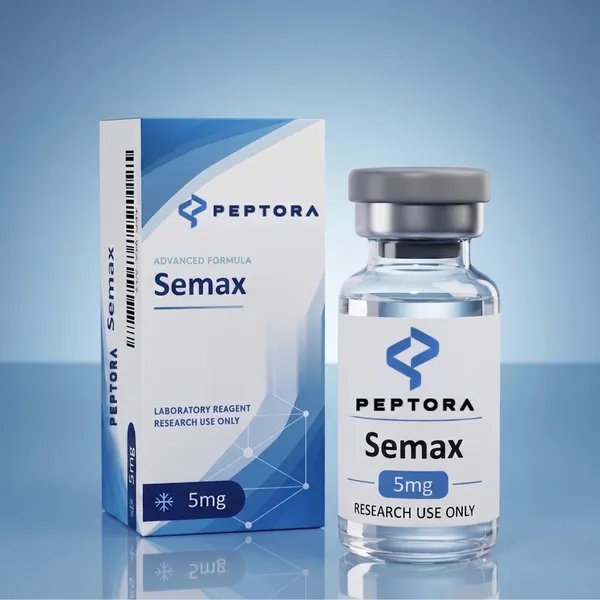
Semax has the sequence Met-Glu-His-Phe-Pro-Gly-Pro. Its first four residues come from adrenocorticotropic hormone (ACTH), the pituitary hormone that drives cortisol production, but Semax is designed so that it keeps the brain-related activity of this region without stimulating the adrenal glands. Dolotov and colleagues describe it as an analogue of the ACTH(4-10) fragment with marked effects on learning and nerve-cell protection in animal studies.
Semax and BDNF
The best-characterised mechanism for Semax involves brain-derived neurotrophic factor (BDNF), a protein that supports the survival and plasticity of nerve cells, and its receptor trkB. Dolotov and colleagues found that a single intranasal application of Semax in rats raised BDNF protein in the hippocampus up to 1.4-fold and trkB phosphorylation, a sign of receptor activation, 1.6-fold. Messenger RNA levels rose three-fold for BDNF exon III and two-fold for trkB. Treated rats also made more conditioned avoidance responses in a learning task. The authors suggest that Semax affects cognitive function by modulating the BDNF/trkB system in the hippocampus.
Selank: a tuftsin analogue
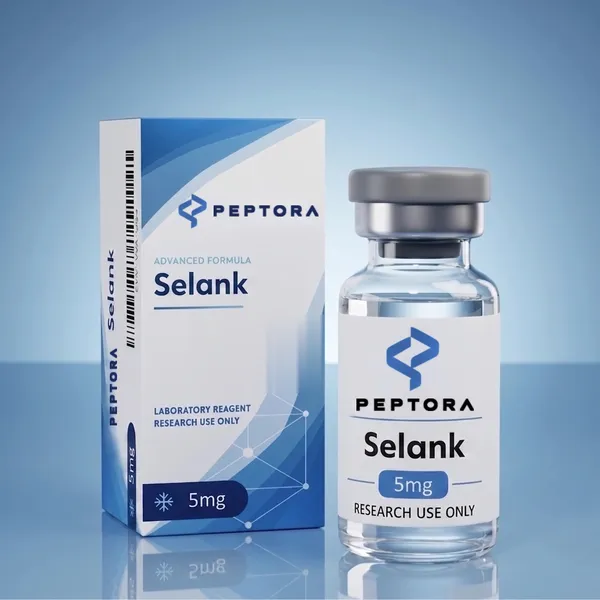
Selank has the sequence Thr-Lys-Pro-Arg-Pro-Gly-Pro. Its first four residues are tuftsin, a natural immunomodulatory peptide derived from immunoglobulin G. Selank is studied mainly for anxiety-related behaviour in animals, and Russian clinical studies compared its spectrum of effects with classic benzodiazepines such as diazepam and phenazepam.
How they compare
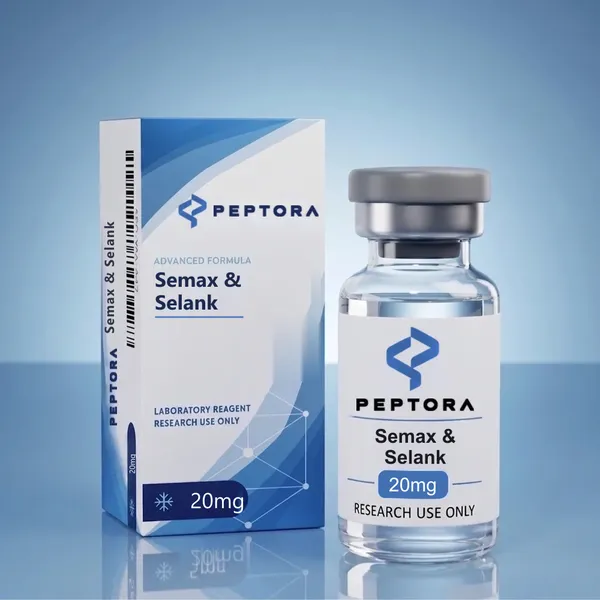
Because their proposed mechanisms differ, some research designs use the two together; we offer a Semax + Selank blend for that purpose.
- Origin: Semax is built on an ACTH fragment; Selank on tuftsin.
- Main research themes: Semax in learning, memory and nerve-cell protection; Selank in anxiety-related behaviour and immune signalling.
- Proposed mechanisms: Semax through BDNF and trkB; Selank through GABAergic modulation and immune-related gene expression.
- Shared design: both end in Pro-Gly-Pro for stability and are studied intranasally in animals.
Reading the evidence
The studies above are careful molecular work, but they are short-term experiments in rodents, and most of the research on both peptides comes from a small number of groups in Russia. Gene-expression changes show what a peptide does to cells at a given moment; they do not by themselves establish longer-term effects. Independent replication outside Russia remains limited.
Pro-Gly-Pro and peptide stability
Short natural peptides such as ACTH fragments and tuftsin are broken down within minutes by peptidases in blood and tissue. The Pro-Gly-Pro tail added to both Semax and Selank makes the chains much harder for these enzymes to cut, because proline-rich sequences resist many common peptidases. Pro-Gly-Pro is also of interest in its own right as a naturally occurring collagen-derived peptide, and fragments of both heptapeptides are studied alongside the full chains. Kolomin and colleagues, for example, tested two Selank fragments next to the full peptide and found that they also changed the expression of immune genes such as Bcl6.
Key terms
- BDNF: brain-derived neurotrophic factor, a protein that supports the survival and plasticity of nerve cells.
- trkB: the receptor for BDNF; its phosphorylation shows that it has been activated.
- GABA: the main inhibitory neurotransmitter in the brain.
- Allosteric modulation: changing a receptor's response by binding at a site other than the main one.
- Tuftsin: a natural four-amino-acid immunomodulatory peptide (Thr-Lys-Pro-Arg).
- ACTH: adrenocorticotropic hormone, the pituitary hormone that drives cortisol release.
Designing studies
The gene-expression studies above found many changes within one to three hours, so timing matters: include early time points as well as later ones. Comparing the peptide with a reference compound, as Volkova and colleagues did with GABA, helps place its effects. For intranasal work in animals, keep the volume and the solvent the same across groups.
In summary
Semax and Selank show how a short natural fragment plus a stabilising tail can create a research peptide with a clear molecular footprint: BDNF signalling for Semax, and GABA-related and immune-related gene expression for Selank. Broader, independent studies are the main gap in the evidence for both.
Notes for laboratory work
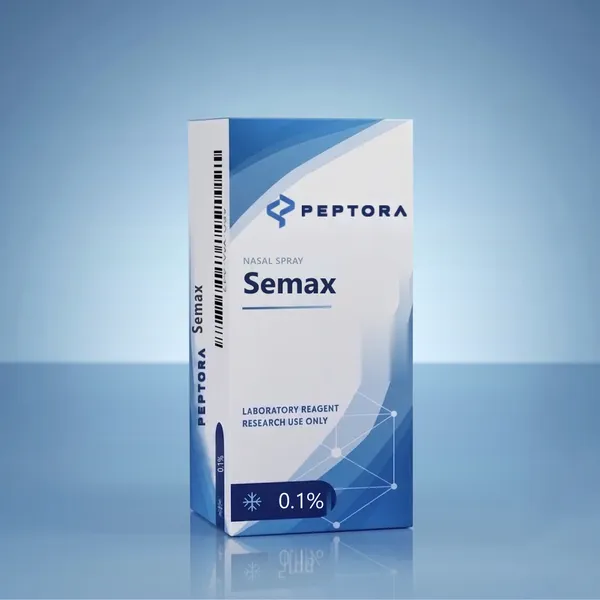
Semax contains methionine, which oxidises easily in the presence of oxygen, light and metal ions, as Li, Schöneich and Borchardt describe. Keep the lyophilized powder sealed, frozen and dark, and prepare solutions shortly before use; Selank, which has no methionine or cysteine, is somewhat less sensitive. Both are small, water-soluble peptides. For intranasal administration in animal models, a ready-made solution can save preparation time: our Semax nasal spray is supplied at a declared 0.1% or 1%. See storing research peptides for general storage.
Frequently asked questions
What is the difference between Semax and Selank?
Semax is built on a fragment of ACTH and is linked to BDNF signalling; Selank is built on the immune peptide tuftsin and is linked to GABA-related gene expression. Both end in Pro-Gly-Pro.
Why do both peptides end in Pro-Gly-Pro?
The tripeptide tail protects them from enzymes that would otherwise break down the active fragments within minutes.
Are Semax and Selank approved medicines?
They are registered in Russia but not approved in the UK, the US or the EU. Peptora Labs sells them for laboratory research only.
References
- Dolotov OV, Karpenko EA, Inozemtseva LS, et al.. Semax, an analog of ACTH(4-10) with cognitive effects, regulates BDNF and trkB expression in the rat hippocampus. Brain Res. 2006. PubMed
- Volkova A, Shadrina M, Kolomin T, et al.. Selank administration affects the expression of some genes involved in GABAergic neurotransmission. Front Pharmacol. 2016. PubMed
- Kolomin T, Shadrina M, Andreeva L, et al.. Expression of inflammation-related genes in mouse spleen under tuftsin analog Selank. Regul Pept. 2011. PubMed
- Li S, Schöneich C, Borchardt RT. Chemical instability of protein pharmaceuticals: mechanisms of oxidation and strategies for stabilization. Biotechnol Bioeng. 1995. PubMed
For laboratory research use only. Not for human or veterinary use. This article summarises published research and is not advice about personal use. You must be 21 or older to order.