
Metabolic research
Retatrutide research: the GIP, GLP-1 and glucagon triple agonist
Updated 14 October 2026 · 4 min read
Retatrutide is a single peptide that activates three hormone receptors at once: GIP, GLP-1 and glucagon. Phase 2 trials reported some of the largest changes in body weight and liver fat seen with any incretin-based molecule so far. Here is how it was designed and what those trials found.
What retatrutide is
Retatrutide, developed by Eli Lilly under the code LY3437943, is a synthetic peptide that acts as an agonist at three receptors: the glucose-dependent insulinotropic polypeptide receptor (GIPR), the glucagon-like peptide-1 receptor (GLP-1R) and the glucagon receptor (GCGR). Like the dual agonist tirzepatide, it carries a fatty-acid modification that binds albumin in the blood, which slows its clearance enough for once-weekly administration in clinical studies.
Why add glucagon?
GLP-1 and GIP receptor agonists mainly reduce food intake and improve insulin secretion. Glucagon is usually thought of as the hormone that raises blood glucose, but glucagon receptor activation also increases energy expenditure and fat burning in the liver. The idea behind retatrutide is to combine lower energy intake from GIP and GLP-1 activity with higher energy expenditure from glucagon activity, while the incretin effects keep glucose in check.
Coskun and colleagues described the discovery of the molecule. In cell assays, it showed balanced activity at the glucagon and GLP-1 receptors and stronger activity at the GIP receptor. In obese mice it reduced body weight and improved glucose control, and the glucagon component added extra body-weight reduction through higher energy expenditure. In a phase 1 single ascending study in people, its tolerability resembled other incretin-based molecules, its pharmacokinetics supported once-weekly administration, and body weight stayed lower for up to 43 days after a single administration.
The phase 2 obesity trial
The main phase 2 trial, published by Jastreboff and colleagues in the New England Journal of Medicine in 2023, enrolled 338 adults with obesity, or with overweight and at least one weight-related condition. Participants received retatrutide at 1, 4, 8 or 12 mg once weekly, some with different starting amounts, or placebo, for 48 weeks.
The mean reductions in body weight were large and depended on the amount:
- At 24 weeks: 7.2% (1 mg), 12.9% (4 mg), 17.3% (8 mg) and 17.5% (12 mg), compared with 1.6% with placebo.
- At 48 weeks: 8.7% (1 mg), 17.1% (4 mg), 22.8% (8 mg) and 24.2% (12 mg), compared with 2.1% with placebo.
- In the 12 mg group at 48 weeks, 100% of participants had lost at least 5% of their body weight, 93% at least 10% and 83% at least 15%, compared with 27%, 9% and 2% with placebo.
Side effects reported in the trial
The most common adverse events were gastrointestinal, such as nausea, and they rose with the amount given. Most were mild to moderate, and starting at 2 mg rather than 4 mg partly reduced them. Heart rate increased in a way that depended on the amount, peaked at 24 weeks and declined after that. These findings are typical of the incretin class but are monitored closely in larger trials.
Type 2 diabetes
Rosenstock and colleagues ran a parallel phase 2 trial in 281 adults with type 2 diabetes at 42 sites in the USA, comparing several retatrutide amounts with placebo and with the GLP-1 receptor agonist dulaglutide over 36 weeks. The primary endpoint was the change in HbA1c at 24 weeks, with HbA1c and body weight at 36 weeks as secondary endpoints. Retatrutide lowered both HbA1c and body weight compared with placebo, with larger effects at higher amounts, supporting further study in people with diabetes.
Liver fat
Because glucagon acts strongly on the liver, liver fat was studied separately. Sanyal and colleagues followed 98 participants from the obesity trial who had metabolic dysfunction-associated steatotic liver disease (MASLD) and at least 10% liver fat. At 24 weeks, the mean relative reduction in liver fat was 42.9% (1 mg), 57.0% (4 mg), 81.4% (8 mg) and 82.4% (12 mg), compared with a 0.3% increase with placebo. Liver fat returned to the normal range (under 5%) in 86% of the 12 mg group and in none of the placebo group. The reductions tracked changes in body weight, abdominal fat and measures of insulin sensitivity and lipid metabolism.
How it compares with dual agonists
Comparisons across trials need care because populations, durations and analysis methods differ. With that caveat, the 48-week figures for retatrutide in phase 2 were higher than those reported for the GLP-1 receptor agonist semaglutide and comparable to or higher than those for the dual GIP and GLP-1 agonist tirzepatide over longer trials. Our article on tirzepatide vs semaglutide covers those trials. Larger phase 3 trials of retatrutide are under way, and retatrutide is not an approved medicine.
Key terms
- Agonist: a molecule that activates a receptor, as opposed to an antagonist, which blocks it.
- GIP: glucose-dependent insulinotropic polypeptide, an incretin hormone released from the upper gut after meals.
- GLP-1: glucagon-like peptide-1, an incretin hormone from the lower gut that boosts insulin release and signals fullness.
- Glucagon: a pancreatic hormone that raises blood glucose and also increases energy expenditure and fat use in the liver.
- HbA1c: a blood marker of average glucose over the previous two to three months.
- MASLD: metabolic dysfunction-associated steatotic liver disease, the current name for fatty liver linked to metabolic conditions.
In summary
Retatrutide is the first triple GIP, GLP-1 and glucagon receptor agonist to report phase 2 data, with large, amount-dependent changes in body weight, HbA1c and liver fat and a tolerability profile typical of incretin-based molecules. Phase 3 trials will show whether these findings hold in larger and more varied populations.
Notes for laboratory work
Retatrutide is a lipidated peptide that binds serum albumin, so the protein content of cell culture media can change how much free peptide reaches receptors in vitro. Account for this when comparing potency across assays, and include reference agonists for each receptor where possible. Store lyophilized material frozen, dry and dark, and prepare solutions shortly before use; see handling lyophilized peptides.
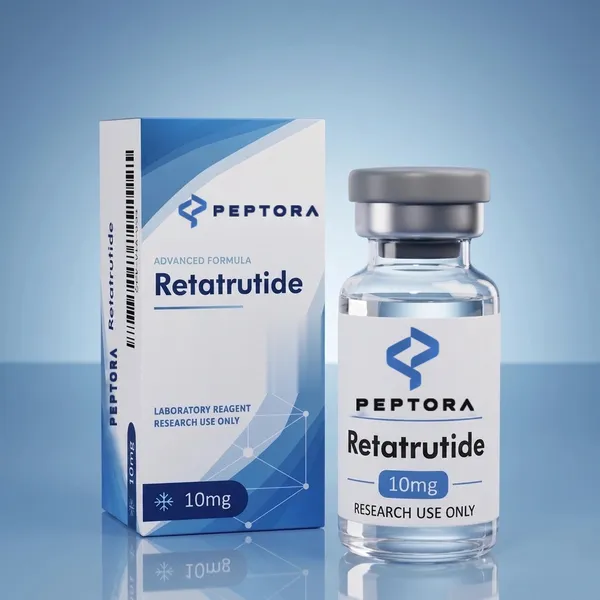
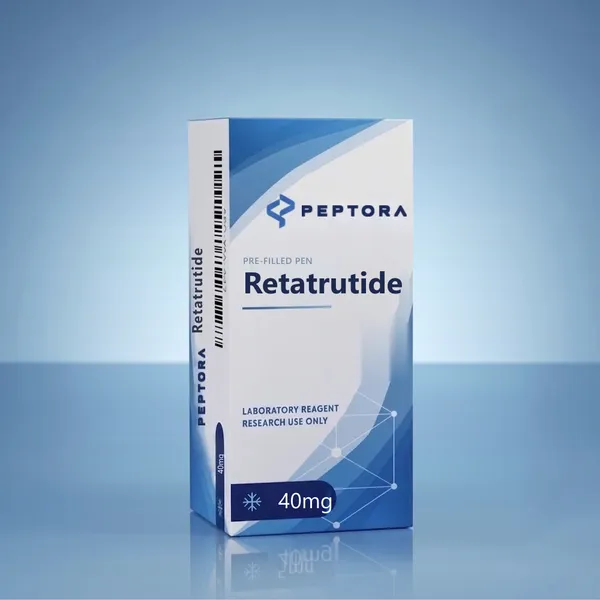
We offer retatrutide in several vial sizes and as a pre-filled pen, each with its current batch report. For the amylin side of metabolic research, see cagrilintide and amylin analogues.
Frequently asked questions
What receptors does retatrutide act on?
Three: the GIP receptor, the GLP-1 receptor and the glucagon receptor, which is why it is called a triple agonist.
What did the phase 2 obesity trial report?
Mean body-weight reductions at 48 weeks of 8.7% to 24.2% depending on the amount, compared with 2.1% with placebo (Jastreboff and colleagues, 2023).
Why does retatrutide include glucagon activity?
Glucagon receptor activation raises energy expenditure and acts on fat in the liver, adding to the reduced food intake from GIP and GLP-1 activity.
Is retatrutide an approved medicine?
No. It is still in clinical development, and Peptora Labs sells it for laboratory research only.
References
- Coskun T, Urva S, Roell WC, et al.. LY3437943, a novel triple glucagon, GIP, and GLP-1 receptor agonist for glycemic control and weight loss: from discovery to clinical proof of concept. Cell Metab. 2022. PubMed
- Jastreboff AM, Kaplan LM, Frías JP, et al.. Triple-hormone-receptor agonist retatrutide for obesity: a phase 2 trial. N Engl J Med. 2023. PubMed
- Rosenstock J, Frias J, Jastreboff AM, et al.. Retatrutide, a GIP, GLP-1 and glucagon receptor agonist, for people with type 2 diabetes: a randomised, double-blind, placebo and active-controlled, parallel-group, phase 2 trial conducted in the USA. Lancet. 2023. PubMed
- Sanyal AJ, Kaplan LM, Frias JP, et al.. Triple hormone receptor agonist retatrutide for metabolic dysfunction-associated steatotic liver disease: a randomized phase 2a trial. Nat Med. 2024. PubMed
For laboratory research use only. Not for human or veterinary use. This article summarises published research and is not advice about personal use. You must be 21 or older to order.