
Growth hormone research
CJC-1295 and ipamorelin: GHRH analogues and GH secretagogues explained
Updated 14 October 2026 · 4 min read
Growth hormone release is controlled by two signals: GHRH and ghrelin. CJC-1295 is a long-lasting GHRH analogue and ipamorelin is a selective ghrelin-receptor agonist. This article explains how each was developed, what the human and animal studies reported, and what the 'DAC' label means.
Two signals that release growth hormone
The pituitary gland releases growth hormone (GH) in pulses. Two main signals drive those pulses. Growth hormone-releasing hormone (GHRH) from the hypothalamus acts on the GHRH receptor. Ghrelin, a hormone mainly from the stomach, acts on a different receptor, the growth hormone secretagogue receptor (GHS-R). Somatostatin acts as the brake. Research peptides target one signal or the other: GHRH analogues such as CJC-1295 act on the GHRH receptor, while growth hormone secretagogues such as ipamorelin act on the ghrelin receptor.
From GHRH to GRF(1-29)
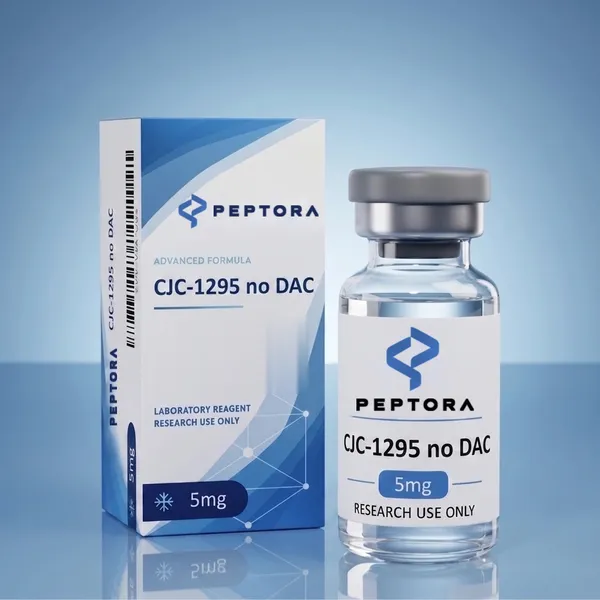
Natural GHRH has 44 amino acids, but its first 29 carry its full activity, which is why research often uses the shorter fragment known as GRF(1-29) or sermorelin. Like natural GHRH, it is broken down within minutes, mainly by the enzyme dipeptidyl peptidase-4 (DPP-4). Researchers made the fragment more stable by swapping four amino acids at vulnerable positions. The result is often called tetrasubstituted GRF(1-29), or modified GRF(1-29), and it is what is sold as CJC-1295 without DAC.
What DAC adds
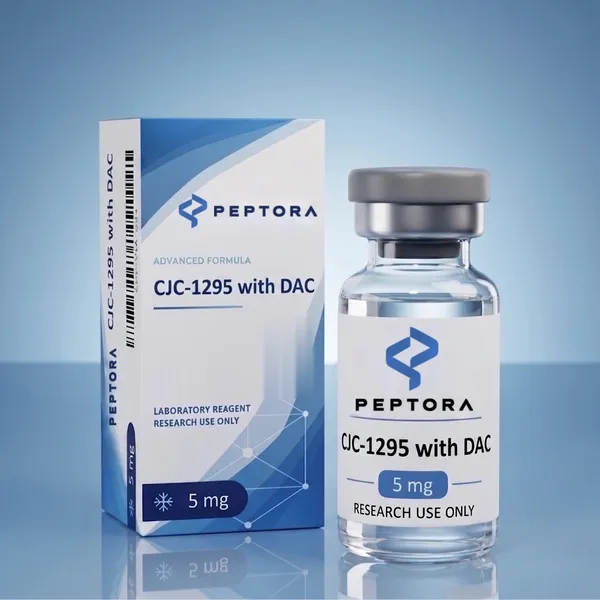
DAC stands for drug affinity complex. Jetté and colleagues at ConjuChem attached a reactive maleimide group to the tetrasubstituted GRF(1-29) so that, once in the bloodstream, it bonds to a free thiol on serum albumin (cysteine 34). Bound to albumin, the peptide is protected from DPP-4 and from fast kidney clearance. In rats, the best compound, named CJC-1295, produced a four-fold larger GH response over two hours than GRF(1-29), was still present in plasma after 72 hours, and could be seen bound to albumin for more than 24 hours.
CJC-1295 in healthy adults
Teichman and colleagues tested CJC-1295 in healthy adults aged 21 to 61 in two randomised, placebo-controlled studies lasting 28 and 49 days. After a single administration, mean plasma GH rose two- to ten-fold for six days or more and mean IGF-I rose 1.5- to three-fold for 9 to 11 days, with larger rises at higher amounts. The estimated half-life of CJC-1295 was 5.8 to 8.1 days, and with repeated administration, IGF-I stayed above baseline for up to 28 days. No serious adverse reactions were reported.
A key question was whether such a long-acting signal would flatten the natural pulses of GH. Ionescu and Frohman measured GH every 20 minutes overnight in healthy young men before and one week after CJC-1295. Pulses continued, with unchanged frequency and size, but the trough level between pulses rose 7.5-fold, mean GH rose by 46% and IGF-I by 45%. The rise in IGF-I was linked to the higher baseline rather than to bigger pulses.
Ipamorelin: the first selective secretagogue
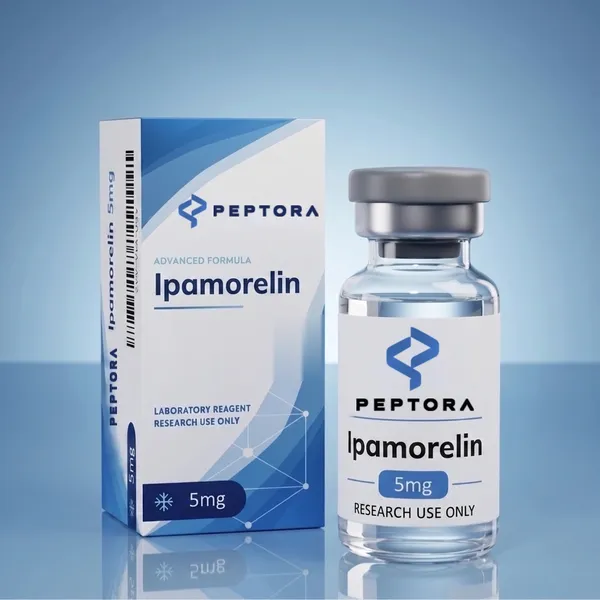
Ipamorelin is a pentapeptide, Aib-His-D-2-Nal-D-Phe-Lys-NH2, developed at Novo Nordisk from the growth hormone-releasing peptide family. Raun and colleagues reported that it releases GH through the same GHRP-type receptor as GHRP-6, with similar potency and efficacy in rat pituitary cells, anaesthetised rats and conscious pigs.
Its distinguishing feature is selectivity. Earlier secretagogues such as GHRP-6 and GHRP-2 also raised ACTH and cortisol. Ipamorelin did not raise ACTH or cortisol beyond the levels seen with GHRH, even at amounts more than 200 times higher than those needed for half-maximal GH release, and it did not affect FSH, LH, prolactin or TSH. Raun and colleagues called it the first GHRP-receptor agonist with a selectivity for GH similar to that of GHRH itself.
Why they are studied together
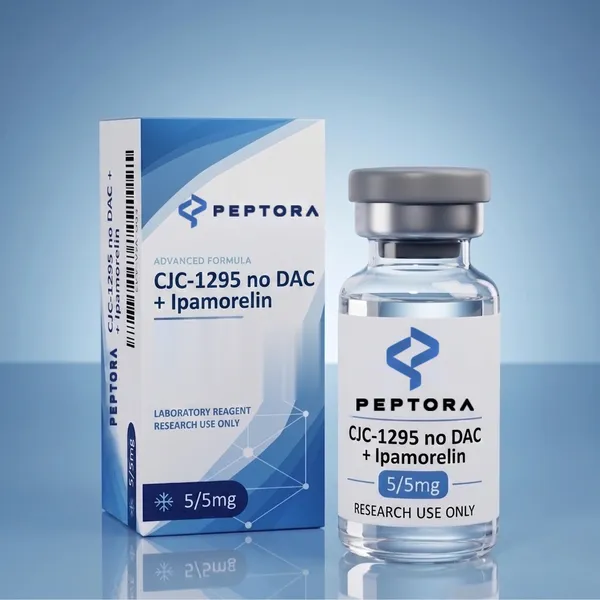
Because GHRH analogues and ghrelin-receptor agonists act through different receptors on the same pituitary cells, combining them is a classic way to study how the two signals interact. A GHRH analogue raises the readiness of the cells to release GH, while a secretagogue triggers release through a separate pathway, so the combined response can be larger than either alone. Ipamorelin is often chosen for such work because its selectivity avoids the ACTH and cortisol effects of older secretagogues. For this kind of design we offer a CJC-1295 (no DAC) + ipamorelin blend.
Choosing between DAC and no DAC
The two have different molecular weights because the DAC version carries the extra lysine and maleimide linker, so check the measured mass on the lab report to confirm which one you have.
- CJC-1295 with DAC: binds albumin, half-life of days, produces a sustained rise in baseline GH and IGF-I. Useful when a long-lasting signal is the point of the study.
- CJC-1295 without DAC (modified GRF(1-29)): short-acting, produces discrete GH pulses closer to the natural pattern. Useful when timing and pulsatility matter.
Measuring growth hormone responses
In research, GH responses are usually described by the peak level and the area under the curve over a few hours, and IGF-I serves as a slower, integrated marker over days. Because GH is released in pulses, frequent sampling is needed to describe it properly, as Ionescu and Frohman did with sampling every 20 minutes overnight.
Key terms
- GH: growth hormone, released by the pituitary gland in pulses.
- IGF-I: insulin-like growth factor I, made mainly by the liver in response to GH and a common marker of GH activity.
- GHRH: growth hormone-releasing hormone from the hypothalamus.
- GHS-R: the growth hormone secretagogue receptor, activated by ghrelin and by GHRPs such as ipamorelin.
- Somatostatin: the hypothalamic hormone that inhibits GH release.
- DPP-4: dipeptidyl peptidase-4, the enzyme that rapidly breaks down natural GHRH.
- AUC: area under the curve, a measure of the total response over time.
Notes for laboratory work
In cell work, remember that albumin in culture media will capture CJC-1295 with DAC, so its free concentration may differ from what you added. GH-releasing peptides are commonly studied in primary pituitary cell cultures, where somatostatin tone and the presence of ghrelin or GHRH in the medium affect the response. Store all three peptides as lyophilized powders, frozen and dry; see storing research peptides. Related products include CJC-1295 with DAC, CJC-1295 without DAC, ipamorelin and the CJC-1295 + ipamorelin pen.
Frequently asked questions
What is the difference between CJC-1295 with and without DAC?
Both are modified GRF(1-29). The DAC version carries a linker that bonds to serum albumin, giving a half-life of days. Without DAC the peptide is short-acting.
Does CJC-1295 stop the natural pulses of growth hormone?
No. Ionescu and Frohman found that pulses continued with the same frequency and size, while the baseline level between pulses rose.
What makes ipamorelin selective?
Unlike GHRP-6 and GHRP-2, it did not raise ACTH or cortisol beyond GHRH levels in pigs, even at amounts over 200 times those needed for GH release.
References
- Jetté L, Léger R, Thibaudeau K, et al.. Human growth hormone-releasing factor (hGRF)1-29-albumin bioconjugates activate the GRF receptor on the anterior pituitary in rats: identification of CJC-1295 as a long-lasting GRF analog. Endocrinology. 2005. PubMed
- Teichman SL, Neale A, Lawrence B, et al.. Prolonged stimulation of growth hormone (GH) and insulin-like growth factor I secretion by CJC-1295, a long-acting analog of GH-releasing hormone, in healthy adults. J Clin Endocrinol Metab. 2006. PubMed
- Ionescu M, Frohman LA. Pulsatile secretion of growth hormone (GH) persists during continuous stimulation by CJC-1295, a long-acting GH-releasing hormone analog. J Clin Endocrinol Metab. 2006. PubMed
- Raun K, Hansen BS, Johansen NL, et al.. Ipamorelin, the first selective growth hormone secretagogue. Eur J Endocrinol. 1998. PubMed
For laboratory research use only. Not for human or veterinary use. This article summarises published research and is not advice about personal use. You must be 21 or older to order.