
Tissue research
BPC-157 research overview: origin, mechanisms and what studies report
Updated 14 October 2026 · 4 min read
BPC-157 is a 15-amino-acid peptide derived from a protein in gastric juice. A large body of mostly rodent research links it to tissue repair, blood-vessel formation and gut protection. Here is what those studies report, how the peptide is thought to work, and where the evidence stops.
What BPC-157 is
BPC-157 is a synthetic pentadecapeptide, a chain of 15 amino acids with the sequence Gly-Glu-Pro-Pro-Pro-Gly-Lys-Pro-Ala-Asp-Asp-Ala-Gly-Leu-Val (GEPPPGKPADDAGLV). It is a partial sequence of a larger protein called body protection compound, first isolated from human gastric juice, which is where the name comes from. In the literature it also appears under the development codes PL 14736 and PL-10.
One property sets it apart from many research peptides: stability. Sikiric and colleagues describe BPC-157 as stable in human gastric juice, which is unusual for a peptide and is one reason it has been studied by oral as well as other routes in animal models. Its molecular weight is about 1,419 g/mol.
Where the research comes from
Most BPC-157 research has come from a single group at the University of Zagreb led by Predrag Sikiric, which has published on the peptide since the early 1990s. Their reviews, such as Sikiric and colleagues in 2016 and Seiwerth and colleagues in 2018, summarise hundreds of experiments in rodents covering the gut, tendons, ligaments, muscle, bone, blood vessels and the nervous system. Independent groups, notably in Taiwan, have since studied specific mechanisms in cell culture. As Gwyer, Wragg and Wilson note in their 2019 review, only a handful of research groups have studied the peptide in depth, which is an important caveat for everything below.
Tendon and ligament studies
Tendons and ligaments have a poor blood supply and few cells, which makes their repair slow and is why they attract so much research. Chang and colleagues studied tendon fibroblasts taken from rat Achilles tendons. BPC-157 did not make the cells divide faster, but it increased the outgrowth of cells from tendon explants, improved cell survival under oxidative stress from hydrogen peroxide, and increased cell migration and spreading. They linked these effects to activation of the FAK-paxillin pathway, a signalling route that controls how cells attach and move.
In a whole-animal model, Cerovecki and colleagues cut the medial collateral ligament of the knee in rats and followed repair for 90 days. Rats given BPC-157 by several routes, including in drinking water and as a local cream, showed consistent functional, biomechanical, macroscopic and histological improvements compared with controls.
Blood vessels and angiogenesis
Several studies point to angiogenesis, the growth of new blood vessels, as a common thread. Hsieh and colleagues found that BPC-157 increased vessel density in the chick chorioallantoic membrane assay and endothelial tube formation in vitro. In rats with reduced blood flow to a hind limb, it sped up the return of blood flow and increased the number of vessels. In human vascular endothelial cells it raised the expression of VEGF receptor 2 (VEGFR2), promoted its internalisation and activated the VEGFR2-Akt-eNOS pathway, while VEGF-A itself did not change.
Seiwerth and colleagues compared BPC-157 with standard angiogenic growth factors such as EGF, FGF and VEGF across gut and musculoskeletal models and argue that BPC-157, used alone and without a carrier, was the most consistently effective in their experiments.
The gut and the brain-gut axis
BPC-157 was first studied as a gut-protective agent, and protection of the stomach and intestinal lining in rodent models of injury remains one of its best-documented effects. The Zagreb group also reports effects beyond the gut: in rodents, BPC-157 modulated serotonin and dopamine systems and protected nerve tissue in models of brain and spinal cord injury. Sikiric and colleagues propose that the peptide acts along the brain-gut axis, though these findings come almost entirely from the same research school.
Proposed mechanisms
These pathways are not mutually exclusive, and no single receptor for BPC-157 has been identified.
- FAK-paxillin activation, supporting cell attachment, spreading and migration (Chang and colleagues).
- VEGFR2 up-regulation and VEGFR2-Akt-eNOS signalling, supporting angiogenesis (Hsieh and colleagues).
- Effects on the early growth response 1 (Egr-1) gene, its repressor NAB2 and the JAK-2 pathway, described by Sikiric and colleagues.
What the evidence does not show
It is important to read this research carefully. Gwyer and colleagues point out that the great majority of studies were done in small rodent models, that the peptide's efficacy has not been confirmed in humans, and that its precise mechanisms are still unclear. Early clinical development under the code PL 14736 was reported, but no large controlled human trials have been published, and BPC-157 is not an approved medicine in the UK, the US or the EU. For research purposes, it is best seen as a well-studied but still experimental peptide.
A short timeline
The overall picture is of a peptide with consistent findings across many rodent models from one main group, supported by a few independent studies of mechanism.
- Early 1990s: the Zagreb group describes the pentadecapeptide and its protective effects in rodent stomach and gut models.
- 2000s and 2010s: rodent studies extend to tendon, ligament, muscle and bone, including the medial collateral ligament study by Cerovecki and colleagues (2010).
- 2011 and 2017: independent cell studies identify FAK-paxillin signalling (Chang and colleagues) and VEGFR2-Akt-eNOS signalling (Hsieh and colleagues).
- 2016 to 2019: reviews by Sikiric, Seiwerth, Gwyer and their colleagues summarise the field and its limits.
Notes for laboratory work
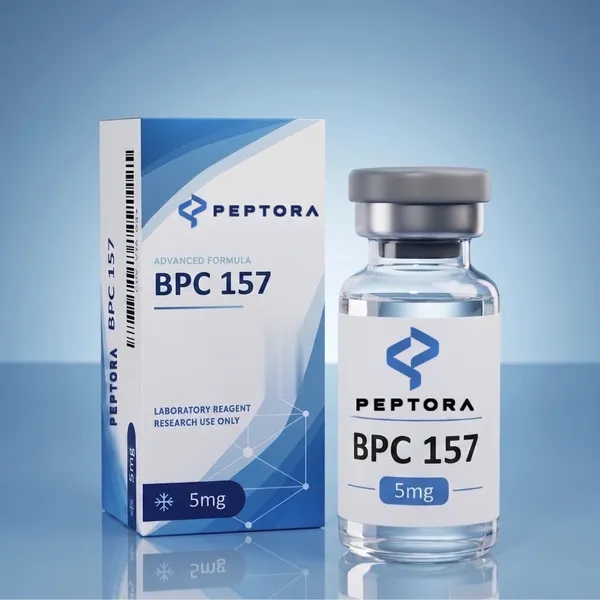
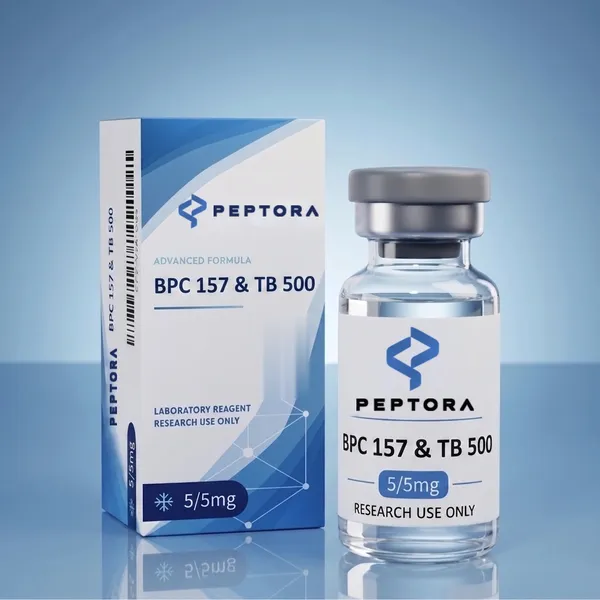
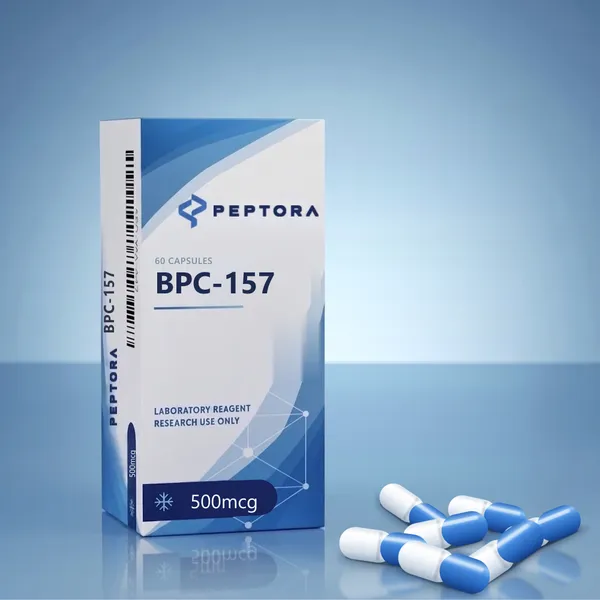
BPC-157 is supplied as a lyophilized powder, most often as an acetate salt; some suppliers offer an arginine salt, which changes the molecular weight of the material and therefore the concentration of a solution made from a given mass. Check the lab report for identity (the measured mass should match about 1,419 g/mol for the free peptide), purity and the salt form. Our BPC-157 is listed with the current batch report, and for studies that pair it with thymosin beta-4 there is a BPC-157 + TB-500 blend. BPC-157 capsules are also available for research designs that need an oral format.
For practical handling, see storing research peptides and handling lyophilized peptides. For how BPC-157 compares with TB-500, see BPC-157 vs TB-500.
Frequently asked questions
What is BPC-157 made of?
It is a synthetic chain of 15 amino acids, GEPPPGKPADDAGLV, taken from a larger protein found in human gastric juice called body protection compound.
Has BPC-157 been studied in humans?
Early clinical development was reported under the code PL 14736, but no large controlled human trials have been published. Almost all studies are in rodents or cells.
How is BPC-157 thought to work?
Studies point to several pathways, including FAK-paxillin signalling in tendon cells and VEGFR2-Akt-eNOS signalling in blood-vessel cells. No single receptor has been identified.
Is BPC-157 an approved medicine?
No. It is not approved in the UK, the US or the EU, and it is sold by Peptora Labs for laboratory research only.
References
- Sikiric P, Seiwerth S, Rucman R, et al.. Brain-gut axis and pentadecapeptide BPC 157: theoretical and practical implications. Curr Neuropharmacol. 2016. PubMed
- Seiwerth S, Rucman R, Turkovic B, et al.. BPC 157 and standard angiogenic growth factors. Gastrointestinal tract healing, lessons from tendon, ligament, muscle and bone healing. Curr Pharm Des. 2018. PubMed
- Gwyer D, Wragg NM, Wilson SL. Gastric pentadecapeptide body protection compound BPC 157 and its role in accelerating musculoskeletal soft tissue healing. Cell Tissue Res. 2019. PubMed
- Chang CH, Tsai WC, Lin MS, et al.. The promoting effect of pentadecapeptide BPC 157 on tendon healing involves tendon outgrowth, cell survival, and cell migration. J Appl Physiol. 2011. PubMed
- Cerovecki T, Bojanic I, Brcic L, et al.. Pentadecapeptide BPC 157 (PL 14736) improves ligament healing in the rat. J Orthop Res. 2010. PubMed
- Hsieh MJ, Liu HT, Wang CN, et al.. Therapeutic potential of pro-angiogenic BPC157 is associated with VEGFR2 activation and up-regulation. J Mol Med. 2017. PubMed
For laboratory research use only. Not for human or veterinary use. This article summarises published research and is not advice about personal use. You must be 21 or older to order.